+ September 13 10:00 – 14:00 Synthesis Panel & Networking (Lunch Included):: A shared wrap-up session featuring open discussion, networking, and a communal lunch bringing together participants from all four workshops.
* Open to participants of ALL four labs (Included with any workshop pass)
—
Registration Early Bird Pass: €12 (Limited availability) Regular Pass: €16
About PVE Labs PVE Labs is a workshop initiative series by Paadmaan Projects, bringing together artists, curators, and researchers who work primarily with the moving image. Designed as an open platform for peer-to-peer exchange, the labs bridge media theory and practical production.
Curator: Foad Alijani
Lab 1: Ecology and Images Led by Erik Peters
* This workshop will be conducted in both Dutch and English.
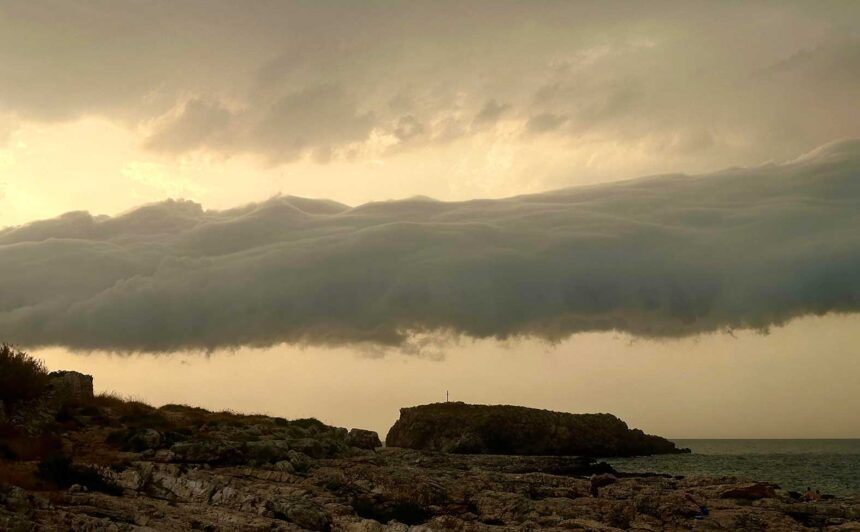
Before we can imagine different futures (for aquatic worlds), we need to ask who gets to imagine them and what those images do. This laboratory explores how stories and images of the sea have long been used as political tools to justify land reclamation, extraction, border violence, and to render entire underwater worlds invisible. At the same time, artists, musicians and communities have used aquatic imagination as a form of resistance, finding ways of knowing that no technology can capture.
The session moves between theory and practice. In the first half, we look at the various ways in which the ocean has been framed and what those framings make (im)possible. In the second half, participants take on the challenge themselves: is it possible to represent a world you cannot enter, or a perspective that is not human? Working with real aquatic ecologies and scientific climate scenarios, groups will develop a climate fiction from or for a multispecies perspective, exploring both the difficulty and necessity of non-human representation.
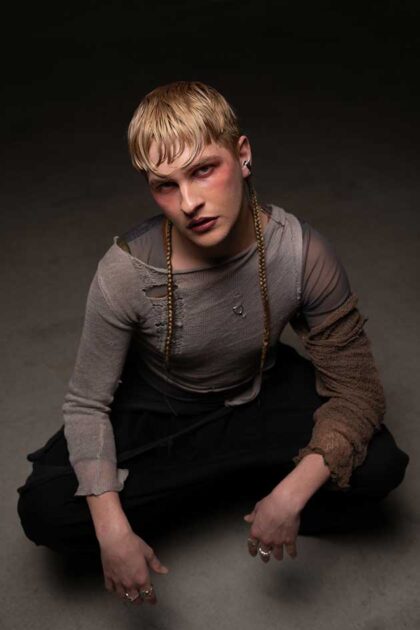
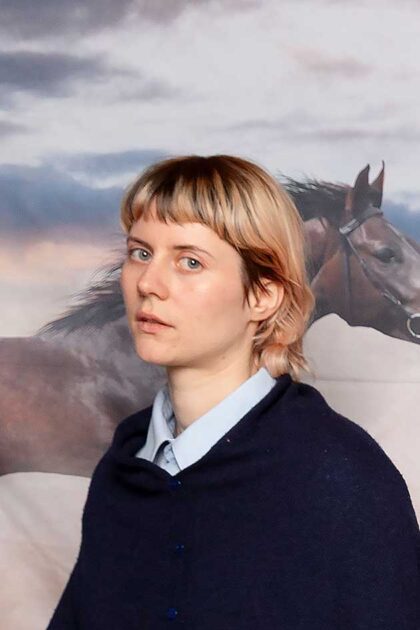
Erik Peters is an interdisciplinary artist and researcher based in the Netherlands, working across new media, audiovisual installations, performance and speculative storytelling. Their practice is rooted in exploring queer ecology and the multispecies entanglements of planetary crises, uncovering how speculative fiction can germinate new modes of relation through collaborative formats of making and staging. Peters constructs immersive scenarios through a range of methods and materials, from machine learning, game engine tool and 3D printing to workshops, audiovisual narration, and performance. Engaging with posthuman theory and science fiction as method, their work explores how collective imagination becomes a generative tool for existing beyond the extractive logics of the present.
Lab 2: Narrative Layers and Images Led by Ilja Schamlé
* This workshop will be conducted in both Dutch and English.
[Narrative at Scale] This session examines narrative as an epistemological and political structure. We address montage, the video essay, the atlas, and counter-mapping as forms that reconfigure linear narration through association, oppositions and contradiction as forms. Participants consider how open-source materials, screen recordings, documents, writing, and found images can produce narrative relations across different scales, from the intimate detail to systemic structures.
Artists develop an audiovisual map from an existing text, research question or collection of materials. Through parallel sequences, annotation, layered timelines, and spatial editing, they test how narrative can move between evidence and speculation, singular experience and systematic critique.
Participants ideally need a computer and video editing software, if this is not possible, please reach out, we can find other ways.
Ilja Schamlé lives and works between Amsterdam and Massiaru, is an artist, cook and writer working across installation art, performance, writing, amateur herbalism, community organising, cooking, design, and scenography. Ilja is interested in societal drives and desires rooted in psychoanalytical theory as a way to diagnose the symptoms of the late capitalist predicament. Symbolisms drawn from metabolic processes, such as constipation and bodily waste, often appear in her artistic research as phenomena that disclose inhibitions and fantasies. She is interested in the obscuring of critical relations and the ways this can give rise to conspiracies. Ilja also has a community practice, focusing on relational transformations, herbal medicine, and social medicine. Yet always cautious when these things get swallowed by wellness culture, for example when they tip over from something emancipatory or critical into something lonely, esoteric and de-politicised. She is also an all-round janitor of a community and art residency space called Massia.
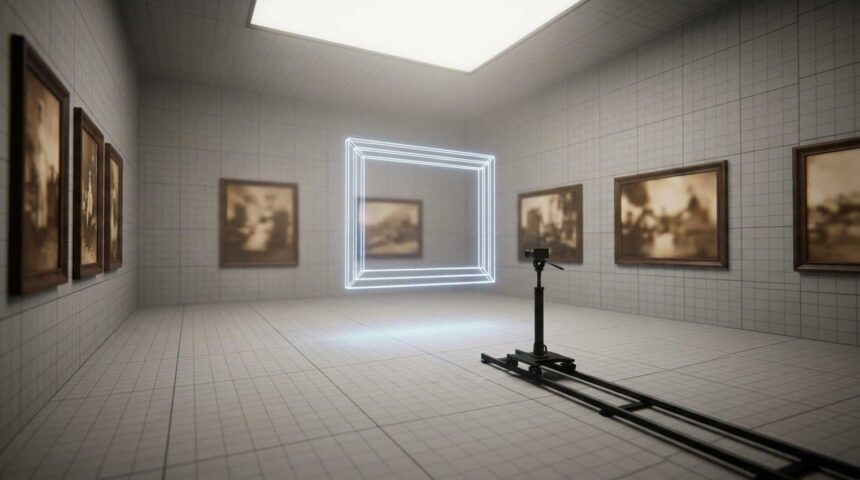
Alongside our physical presence, we continuously inhabit a parallel virtual existence composed of the data we produce, broadcast, and passively generate within space. This workshop redefines the concept of the moving image by treating participants themselves as literal moving images, where bodily movement through physical environments forms an ongoing, invisible sequence of data frames. Using an augmented reality pipeline, participants will transform their physical trajectory into a spatial canvas, translating real-time movement and narrative into anchored visual presence. Rather than treating a site as a container for physical objects, the environment itself becomes a living museum dedicated to the non-linear image sequences of virtual existence. Through an AR app, participants physically move their phones to leave AI generated images spatially anchored, keeping these generated image sequences virtually in the space.
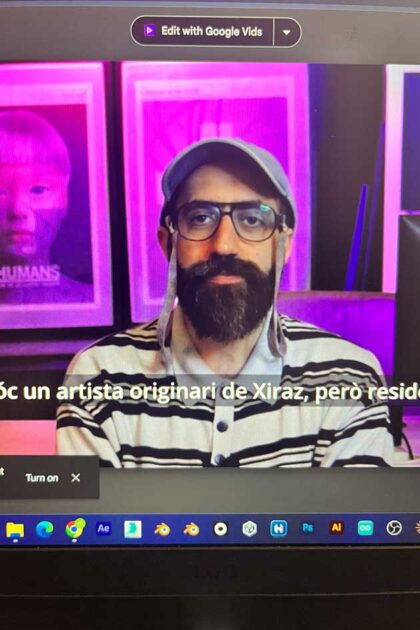
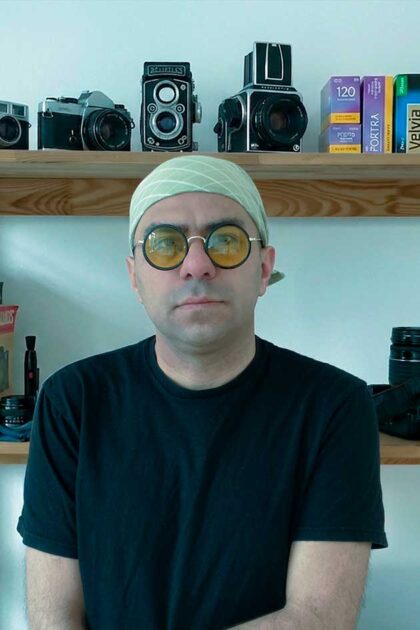
Mohsen Hazrati (b. 1987 in Shiraz, Iran) is a Berlin-based artist. He graduated with a BA in Graphic Design from Shiraz Art Institute of Higher Education in 2012, minoring in new media and digital art, and co-founded DAHProject in Shiraz. His works and research, focused on the intersection of literature and digital technologies, have been presented at conferences and events such as Universität der Künste Berlin, the State Academy of Fine Arts Stuttgart, IAM Weekend Barcelona, EVA London, UCL MAL London, ELO University of Central Florida, Goldsmiths London, TEDx Mollasadra St, and more. He was also awarded the first VR Prize from Deutsche Kredit Bank (DKB) 2024. Mohsen’s art has been exhibited and featured in museums, festivals, and platforms such as CCCB Museum Barcelona, Art Basel Miami, Art Dubai, NFT NYU, ARS Electronica, IMPAKT Festival, HAL Berlin, Grafikenshus Museum, Peer to Space, RadianceVR, Espronceda, Synthesis, Triennale Kleinplastik Fellbach, Transfer Gallery, Enter Art Fair Copenhagen, Next Level Festival Hamburg, and others. He has received residencies and fellowships, including Akademie Schloss Solitude in Stuttgart and Rizq Art Initiative in Abu Dhabi.
This lab explores the mnemonic potential of the moving image. The theoretical session investigates the archival impulse and how video functions as a tool for both personal and collective memory. The lecture explores how the manipulation of time-scales—such as slow-motion or frame-rate modulation—can evoke different historical or psychological states. In the practical application, artists work on a video sketch that blends contemporary observation with archival aesthetics. By experimenting with the texture of the image and the pacing of the edit, participants learn how to use the medium to narrate the passage of time, the fragility of memory, and the reconstruction of the past through mnemonic narration.
Foad Alijani is a media artist whose work draws from memory and imagination. Through imaginal maps, installations, and film, his research-led practice inhabits lived experience, moving across the terrain of embodied perception. Central to his practice is the concept of the image-event, concerned with the emergence of images. He explores how inner and outer worlds intersect and transform one another, forming an architecture of experience. Since 2018, he has led his curatorial initiative, Paadmaan Projects, centered on experience as a course of dialogue through art, science, and technology.