Open post

LASER Talks Tehran

Paadmaan projects in Collaboration with Komod Space:
LASER Talks Tehran #7 + Video Installation

Chairs:
Maryam Razi and Foad Alijani

Speakers:
– Aynaz Raoufian [Visual Artist]
Topic: Mind Cancer; Phenomenology of Cancer in Daily Life
– Farid Khani Tarakameh [MD]
Topic: Art and Medicine – Comments on Aynaz Raoufian’s Works
– Sarshar Dorosti [Media Artist]
Topic: Using the Brain Waves as a Gauge for Perception of Fractal Animation

Time and Date:
February 22, 2022, from 18:00 to 20:00 Tehran Time
Location: Komod Space, on the Corner of Yaghma and Darband St., Tajrish, Tehran.
Sponsors:
Paadmaan projects
Komod Space
Sam Café (Refreshment Sponsor)

Raoufian’s video installation is on display at Komod Space from February 22 to 29, 2022.

Aynaz Raoufian [Visual Artist]
Topic: Mind Cancer; Phenomenology of Cancer in Daily Life

The Mind Cancer collection comprises assembled or modeled everyday objects and spaces associated with cancer. These objects are created from the perspective of an observer who metaphorically has brain cancer, seeing everything around them or their memories through the lens of this disease. The purpose of this collection is to depict the thoughts and minds of people who have carcinophobia (the fear of getting cancer), are suffering from cancer, or are experiencing the deep grief of losing others to this disease. These individuals focus on minor details of their lives and cannot escape this preoccupation.

The collection has three subsets: Wear Cancer, Eat Cancer! and Everyday Life with Cancer.

Wear Cancer is an invitation to understand the challenges of cancer. It features sculptures made of fibers and fabrics, wire, latex, papier-mâché, etc., that sit on the body, altering appearance, placing a heavy burden, and changing natural movements and functions. These sculptures evoke the difficult times a person with cancer endures, fostering a shared understanding. One piece consists of cancer tumors shaped like a human face, attached to a plexiglass box with a space for the neck and a mirror in front, both hung from the ceiling. People can place their heads in the box and see themselves in the mirror with these cancer tumors on their faces.

Eat Cancer! is an experimental project where edible sculptures resembling cancerous tissues are presented for the audience to eat. This project aims to diminish the magnitude and perceived danger of cancer, suggesting it can even be bypassed and swallowed. By framing this extreme issue in a satirical paradox, the project seeks to reduce fear and weaken the psychological impact of the disease on sufferers and others.

Everyday Life with Cancer is a cancer-themed fashion collection. Cancer tissue forms are subtly integrated into the clothing designs, creating a sculptural effect. Although wearable, these clothes transcend ordinary fashion, overshadowing daily movements and forcing the body into uncomfortable and unbearable positions. The overall goal is to metaphorically convey the hardships of cancer and its disruptive impact on a person’s life.

Farid Khani Tarakameh [MD]
Topic: Art and Medicine – Comments on Aynaz Raoufian’s Works

The birth of art and medicine occurred close together, both owing their origins to the concept of pain. Pain abstraction is evident in works of art, which have existed for about 16,000 years. Cancer, one of the most complex and ancient causes of pain, has been increasingly significant in recent years due to its physiopathological findings, though it is even found in dinosaurs, as paleopathology indicates.

Beyond pain, other medical signs have captured artists’ attention. Ancient Egyptian murals abound with depictions of medical discoveries and instructions. Circumcision, dating back to 3400 BC, is depicted in ancient Egyptian murals, predating Judaism and Islam. Prehistoric art, like the Venus sculptures, illustrates obesity, a concept that has drastically changed in recent centuries with shifting aesthetic attitudes.

Recent artworks present these concepts differently. The notions of madness and melancholy have also intrigued artists, exemplified by the works of the Dutch painter Hieronymus Bosch, whose painting The Ship of Fools expresses human fear of what later became known as schizophrenia. Plague and leprosy are other diseases explored by artists since antiquity.

In the works of Aynaz Raoufian, we encounter several keywords related to cancer: conquest, extinction, influence, expansion, encroachment, mass, and volume. For instance, in one piece, a grotesque mass engulfs a beautiful face, symbolizing cancers of the facial bones, parathyroid glands, larynx, and throat. This visual representation effectively conveys the nature of these cancers.

Sarshar Dorosti [Media Artist]
Topic: Using Brain Waves as a Gauge for Perception of Fractal Animation

In this research, I describe how the complexity of visual stimuli influences the complexity of information processing in the brain. We recorded EEG signals of fifteen healthy participants while they were exposed to several 2D fractal animations. The fractal dimension of each frame of the animation was estimated using the box-counting method. Subsequently, the fractal dimensions of 32 EEG channels were estimated in a frequency-specific manner. Then, the association between the pattern of fractal dimensions of the animations and the pattern of fractal dimensions of EEG signals was calculated using Pearson’s correlation algorithm.

The results indicated that fractal animation complexity is primarily sensed by changes in the fractal dimension of EEG signals in the centro-parietal and parietal regions. This finding suggests that as the complexity of visual stimuli increases, the brain’s information processing mechanisms also enhance their complexity to better attend to and comprehend the stimuli.

Video Installation / Aynaz Raoufian

Open post

Supermarket Art Fair

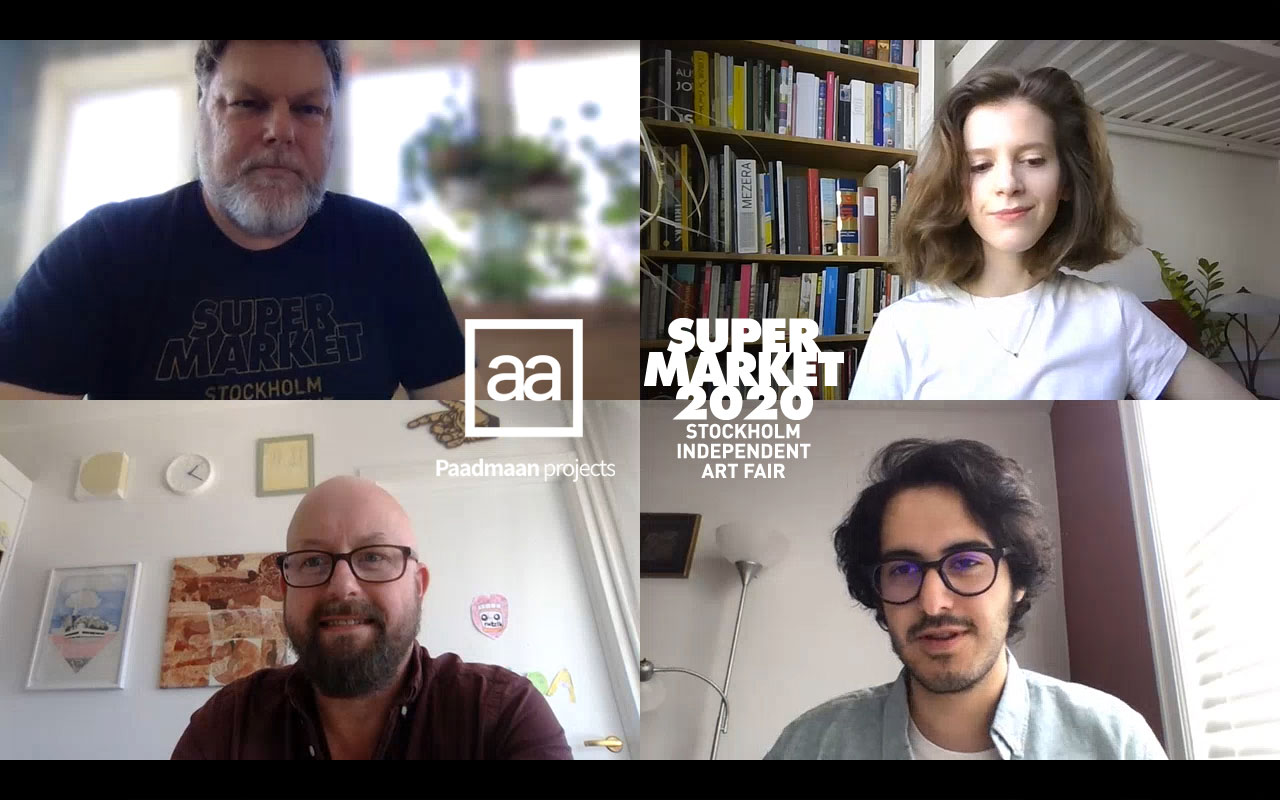
/// Paadmaan projects, Tehran: Interview with Supermarket’s creative directors.
posted on April 28, 2020 by Supermarket Art Fair

Paadmaan projects, along with artist Rouzbeh Akhbari, approached Supermarket’s creative directors to answer several questions about the art fair and the artist-run art scene in general.

Paadmaan was invited to the Supermarket Art Fair 2020, which was canceled due to COVID-19.

—
SUPERMARKET is an international artist-run art fair that provides a showcase of artists’ initiatives from all over the world. Supermarket’s aim is to display unique projects and ideas, create opportunities for new networks on the Swedish and international art scene, and share the passion and vitality that are present in the independent art world.
Supermarket has been arranged in Stockholm since 2007 by a small group of organizers most of whom are artists themselves. Supermarket is a development of Minimarket, which was held at Konstnärshuset (artists’ house) in February 2006 in reaction to the new commercial art fair Market.

Open post

Like a Shadow, Like a Thought

/// Film screening and director talk

Like a Shadow, Like a Thought
A documentary film about Marcos Grigorian
Directed by Hamidreza Zeinali

Like a Shadow Like a Thought is a portrait documentary that delves into the adventurous life of Marcos Grigorian, a pioneering Iranian-Armenian artist (1925-2007). Born into an Armenian family who fled from Van to Kars during the Armenian genocide in 1915, Marcos studied painting at the Kamal-al-Molk School in Iran before furthering his education at the Fine Arts Academy in Rome, Italy, graduating in 1954 and returning to Iran. His contributions to Iranian modern art include:

– Establishing the Static Gallery in Tehran as a hub for young modernists.
– Researching Iranian traditional art and preserving tea house paintings.
– Supporting surviving painters of this style such as Hosein Gollar Aghasi and Mohammad Modabber.
– Representing the Iranian pavilion at the Venice Biennale and serving as a juror in 1958.
– Overseeing the graphic department of the General Directorate of Fine Arts.
– Organizing the first Tehran Biennale.
– Founding the Independent Painters Group in 1975 with other Iranian artists.

Marcos Grigorian also taught at university and appeared in cinema. The documentary includes insights from prominent Iranian artists and critics such as Aidin Aghdashloo, Janet Lazarian, Sadegh Tabrizi, Javad Mojabi, Mohammad Ehsaei, Hossein Mahjoobi, Reza Bangiz, and Mehdi Hosseini.

Date: April 24, 2019
Time: 6:30 – 8:30 pm
Location: Gaah-Art, Mozaffar Brothers St (between Enghelab St and Bozorgmehr St), No. 70, Block No. 3, Third floor, Flat No. 38